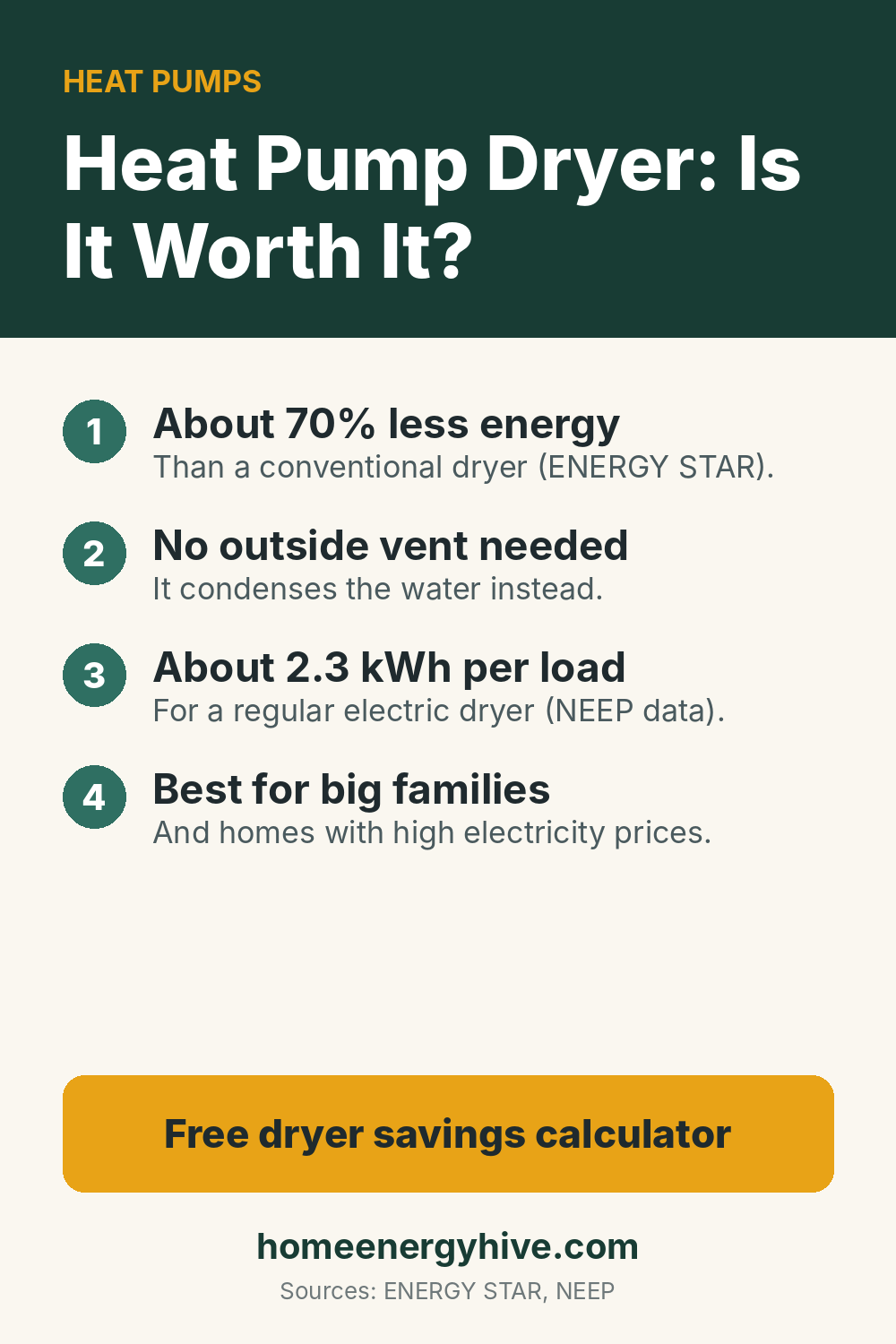
- ENERGY STAR says a heat pump dryer uses around 70% less energy than a conventional dryer.
- It needs no outside vent: it reuses the air and condenses the water, which you drain or empty from a tank.
- A metered study of conventional electric dryers found about 993 kWh a year over about 439 loads, roughly 2.3 kWh per load (NEEP; our division).
- It pays back fastest for big families with high electricity prices, and in homes with no dryer vent.
A heat pump dryer is the efficiency leader among clothes dryers: ENERGY STAR says all heat pump dryers meet its Most Efficient criteria. It costs more up front, though, and dries a little differently from the dryer you grew up with. This guide explains how it works, what it can save, the practical trade-offs, and gives you a calculator to see if it pays off for your household.
How a Heat Pump Dryer Works
A conventional electric dryer heats air with an element, blows it through the clothes and pushes the hot, damp air outside through a vent. A heat pump dryer works as a closed loop. ENERGY STAR explains that it heats the air, uses it to take moisture from the clothes, then passes that humid air through a condenser to remove the water without losing much heat, and reuses the air.
The water collected from the clothes is either drained or emptied from a holding tank. Because no hot air leaves the house, there is no need for a dryer vent.
How Much Energy Does a Heat Pump Dryer Save?
ENERGY STAR says certified heat pump dryers use around 70% less energy than conventional dryers, and that people with high dryer use and high electricity rates have the most to gain.
How much is that in kWh? A metered study by NEEP of recently bought conventional electric dryers in New England estimated about 993 kWh a year for an average household, over about 439 loads. That works out to roughly 2.3 kWh per load (our division). Saving 70% of 993 kWh would be about 695 kWh a year. At 18.16¢ per kWh, the U.S. average in August 2026 (EIA), that is about $126 a year. Your number depends on your loads and your rate.
Example values only. Yearly savings = loads × 52 × kWh per load × savings % × price.
Heat Pump Dryer Pros and Cons
| Pros | Cons |
|---|---|
| Around 70% less energy (ENERGY STAR) | Higher purchase price |
| No dryer vent needed: can save installation cost where there is no vent | Water must be drained or the tank emptied after each load |
| Lower drying temperatures | Uses a refrigerant; choose a low-GWP one such as R-290 |
On drainage, ENERGY STAR notes that if a drain is not practical, the tank must be emptied after every load, and that many manufacturers sell a kit to use the washer’s drain instead. On refrigerants, it recommends choosing a model with a low global warming potential refrigerant, such as R-290.
Who Should Buy a Heat Pump Dryer?
- Large households that run the dryer most days. More loads mean more savings.
- High electricity prices. The same kWh saved is worth more where power is expensive.
- Homes without a dryer vent, such as apartments, condos or a laundry closet inside the home. ENERGY STAR notes that skipping a new vent can mean significant installation savings.
If you only run a few loads a week and your rate is low, an ENERGY STAR certified conventional dryer may be the cheaper choice overall. ENERGY STAR says a full-size certified electric dryer saves about $210 over its life. See our guide on whether ENERGY STAR appliances are worth it.
Dry for Less With Any Dryer
- Clean the lint filter after every load. ENERGY STAR says it improves air circulation and efficiency, and is an important safety step. If you use dryer sheets, scrub the filter regularly, since they leave a film.
- Use the moisture sensor instead of a fixed timer, so the dryer stops when clothes are dry.
- Dry full loads. ENERGY STAR notes that drying a single towel for 30 minutes costs about as much as drying a full load for the same time.
- Use delayed start with a time-of-use rate to dry when power is cheaper.
- Heat pump dryer operation, savings, drainage and refrigerant advice from ENERGY STAR’s clothes dryer page
- Baseline dryer energy from the NEEP Residential Electric Clothes Dryer Baseline Study
- Electricity price from the EIA’s Electric Power Monthly
- The calculator is our own math
No company pays to appear here, and we have not tested products in person.
Frequently Asked Questions
How much energy does a heat pump dryer save?
ENERGY STAR says certified heat pump dryers use around 70% less energy than conventional dryers.
Does a heat pump dryer need a vent?
No. It reuses the air and condenses the moisture into water, so no outside vent is needed. The water goes to a drain or a tank.
How much electricity does a regular dryer use per load?
A metered study of conventional electric dryers by NEEP found about 993 kWh a year over about 439 loads, roughly 2.3 kWh per load. Your dryer and loads will differ.
Is a heat pump dryer worth it?
It pays back fastest for households with many loads, high electricity prices or no dryer vent. Use the calculator with your own numbers and the price difference.
Our Verdict
A heat pump dryer uses around 70% less energy than a conventional dryer and needs no vent, which makes it a strong choice for busy households, high electricity prices and homes without a vent. For light users with cheap power, the higher price can take many years to pay back. Run the calculator with your loads and rate, and whichever dryer you choose, clean the lint filter after every load.
Keep reading
- Are ENERGY STAR Appliances Worth It?: payback for other appliances
- How to Read Your Electric Bill: time-of-use rates explained
- How Many Watts Does a Refrigerator Use?: another big kitchen appliance
Save this guide on Pinterest