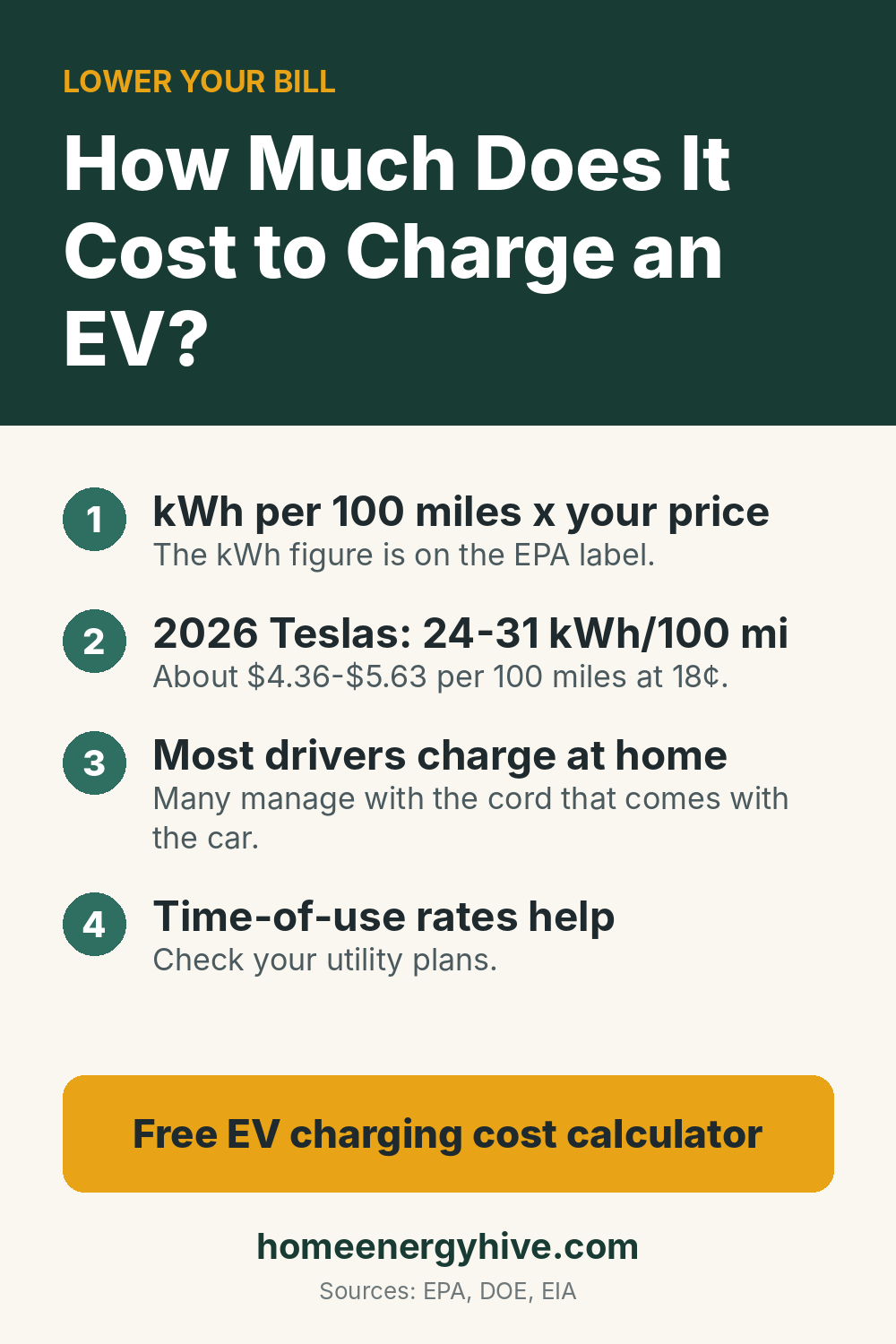
- Cost to charge = kWh used per 100 miles (on the EPA label) × your price per kWh.
- 2026 Tesla models are rated 24 to 31 kWh per 100 miles by the EPA. At 18¢ per kWh, that is about $4.36 to $5.63 per 100 miles.
- Most drivers charge overnight at home; the DOE says many meet daily needs with the Level 1 cord that comes with the car.
- Time-of-use rates can make overnight charging cheaper. Check your utility’s plans.
How much does it cost to charge an electric car? At home, usually far less than filling a gas tank, but the exact number depends on two things you can look up: how many kWh your car uses per 100 miles, and what you pay per kWh. This guide shows the simple formula from the Department of Energy, real EPA figures for 2026 Tesla models, and a calculator for your own car and rate.
How Much Does It Cost to Charge an Electric Car? The Formula
The DOE’s Alternative Fuels Data Center explains that an EV’s efficiency is measured in kWh per 100 miles. Multiply it by your electricity price to get the cost. Its example: at 10.7¢ per kWh, a car using 27 kWh per 100 miles costs about 3 cents per mile.
However, electricity costs more today. The U.S. residential average was 18.16¢ per kWh in August 2026, according to the EIA, and it varies a lot by state. For that reason, use your own bill: total dollars divided by kWh gives your real rate.
How Much Does It Cost to Charge a Tesla?
The EPA rates each model on fueleconomy.gov. Here are the 2026 Tesla ratings, with our cost estimates at 18.16¢ per kWh:
| Model | EPA kWh per 100 miles | Cost per 100 miles | Cost per 1,000 miles |
|---|---|---|---|
| 2026 Tesla Model 3 Standard RWD | 24 | $4.36 | $44 |
| 2026 Tesla Model Y Standard RWD (18-inch wheels) | 24 | $4.36 | $44 |
| 2026 Tesla Model 3 Premium RWD | 25 | $4.54 | $45 |
| 2026 Tesla Model Y Long Range RWD | 25 | $4.54 | $45 |
| 2026 Tesla Model Y Standard AWD | 26 | $4.72 | $47 |
| 2026 Tesla Model 3 Premium AWD | 26 | $4.72 | $47 |
| 2026 Tesla Model S | 27 | $4.90 | $49 |
| 2026 Tesla Model Y Long Range AWD | 27 | $4.90 | $49 |
| 2026 Tesla Model 3 Performance | 30 | $5.45 | $54 |
| 2026 Tesla Model S Plaid | 31 | $5.63 | $56 |
Ratings from fueleconomy.gov (2026 models). Costs are our calculation at the U.S. average price and do not include charging losses or fees.
Why some versions cost more to charge
As the table shows, bigger wheels, all-wheel drive and performance versions use more energy. For example, the Model 3 Performance needs 30 kWh per 100 miles, while the Standard RWD needs 24. In other words, the same trip can cost about a quarter more. The same pattern applies to other brands, so look up your exact model on fueleconomy.gov.
Example values only. U.S. regular gasoline averaged $3.995 a gallon in the week of November 9, 2026 (EIA). Some energy is lost while charging, so your meter will show a little more than these figures.
What Changes Your Real Charging Cost
- Your rate plan. The DOE notes that home charging costs depend on the time of day and the equipment, and that some utilities offer time-of-use rates or incentives for EV owners. Charging overnight on a cheaper rate can cut the cost noticeably. Our guide on reading your electric bill explains time-of-use rates.
- Public fast charging. Public stations set their own prices, which are often higher than home electricity. Check the price in the app before you plug in.
- Weather and driving. In addition, highway speed, heating the cabin in winter and bigger wheels all raise kWh per 100 miles.
Level 1 or Level 2 at Home?
According to the DOE, most EV drivers charge overnight at home. Many meet their daily driving with the Level 1 cord that comes with the car, at no extra cost, as long as an outlet on a dedicated circuit is near where they park. A Level 2 (240-volt) charger makes sense for longer commutes, irregular schedules or large batteries that need more than one night.
For Level 2, the DOE recommends safety-certified equipment, such as ENERGY STAR certified chargers, and a certified electrical contractor. An electrician can tell you whether your home has enough electrical capacity; if not, circuits can be added. Installations must meet local codes, and permits may be required. Our guide to the best home EV chargers covers the options.
Charging vs Gas: A Fair Comparison
To compare fairly, first put both in cost per mile. For the electric car: kWh per 100 miles × price ÷ 100. For a gas car: gas price ÷ miles per gallon. The calculator above does both if you add your gas car’s mpg and the local gas price. Still, maintenance, insurance and purchase price also differ, so fuel is only part of the picture.
- Vehicle efficiency from the EPA ratings on fueleconomy.gov (2026 Tesla models)
- Formula and home charging guidance from the DOE’s Alternative Fuels Data Center
- Electricity and gasoline prices from the EIA
- Table and calculator are our own math
No company pays to appear here, and we have not tested products in person.
Frequently Asked Questions
How much does it cost to charge an electric car at home?
Multiply your car’s kWh per 100 miles by your price per kWh. At 25 kWh per 100 miles and 18 cents per kWh, that is $4.50 per 100 miles, or about 4.5 cents per mile.
How much does it cost to charge a Tesla?
2026 Teslas are rated 24 to 31 kWh per 100 miles by the EPA. At 18.16 cents per kWh, that is about $4.36 to $5.63 per 100 miles at home, before charging losses.
Is it cheaper to charge at night?
Often, if your utility offers a time-of-use or EV rate with lower overnight prices. On a flat rate, the time of day does not change the price.
Do I need a Level 2 charger?
Not always. The DOE says many drivers meet daily needs with the Level 1 cord that comes with the car. Level 2 helps with long commutes, irregular schedules or large batteries.
Our Verdict
How much does it cost to charge an electric car? At home, roughly 4 to 6 cents per mile at today’s average electricity price for most Teslas, based on EPA ratings. Your own cost depends on your car’s kWh per 100 miles and your rate, so use the calculator with your bill. A time-of-use plan and overnight charging usually bring it down further.
Keep reading
- Best Home EV Chargers: Level 2 options for your garage
- How to Read Your Electric Bill: time-of-use rates explained
- Average Electric Bill by State: compare your rate
Save this guide on Pinterest