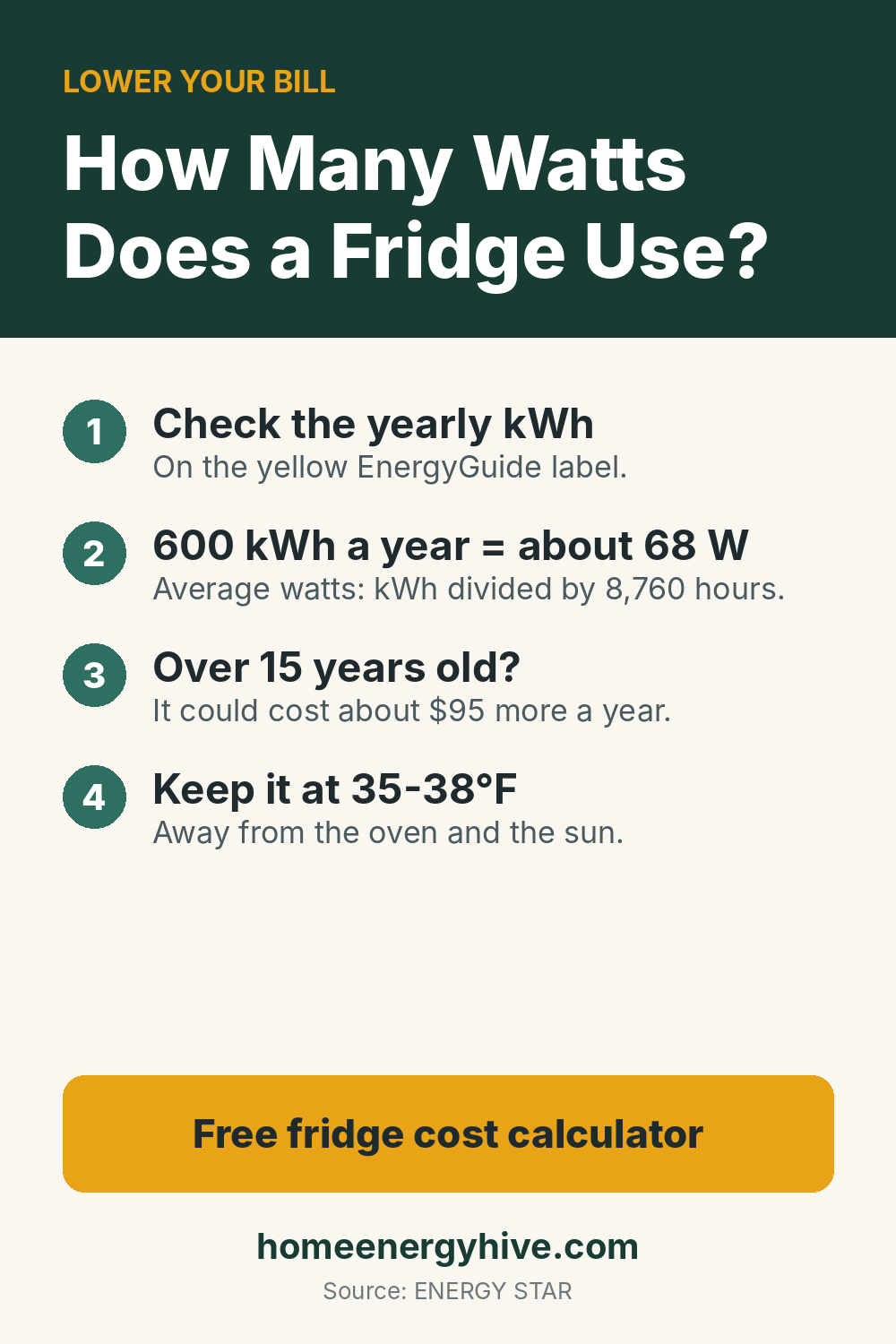
- A fridge cycles on and off all day, so the useful number is its yearly kWh, printed on the yellow EnergyGuide label.
- Divide yearly kWh by 8,760 hours to get the average watts. For example, 600 kWh a year is about 68 W on average (our calculation).
- ENERGY STAR says refrigerators over 15 years old could be costing about $95 a year more to run, and an old fridge uses about 20% more energy than a certified one.
- Keep it at 35 to 38°F, away from the oven and sun, with a few inches of space behind it.
How many watts does a refrigerator use? The honest answer is “it changes all the time.” The compressor switches on and off to hold the temperature, so a single watt figure can mislead you. This guide shows the number that matters, how to turn it into watts and dollars, and when an old fridge is worth replacing, using ENERGY STAR data.
How Many Watts Does a Refrigerator Use? Watts vs kWh
Watts measure power at one moment. Kilowatt-hours (kWh) measure energy over time, and your bill charges for kWh. Because a refrigerator’s compressor runs only part of the time, its power keeps changing, but its yearly energy is fairly steady.
That is why new refrigerators carry a yellow EnergyGuide label with the estimated yearly electricity use in kWh. To turn it into an average power figure, divide by the 8,760 hours in a year:
| EnergyGuide label (kWh/year) | Average power | Cost per year at 18¢/kWh |
|---|---|---|
| 400 kWh | about 46 W | $72 |
| 600 kWh | about 68 W | $108 |
| 800 kWh | about 91 W | $144 |
Our calculation. The price is close to the U.S. residential average of 18.16¢ per kWh in August 2026 (EIA).
When the compressor is actually running, the fridge draws more than this average, and it can draw more for a moment as the compressor starts. If you are sizing a generator or a portable power station for a fridge, use the running and starting figures in the appliance manual or on the nameplate, not the average.
Example values only. Average watts = kWh per year × 1,000 ÷ 8,760.
What Makes One Fridge Use More Than Another
ENERGY STAR’s buying guidance points to a few design choices:
- Size: generally, the larger the refrigerator, the more energy it uses. The most efficient models are typically 16 to 20 cubic feet.
- Freezer position: models with the freezer on top tend to use the least energy, compared with bottom-freezer and side-by-side models.
- Number of doors: fewer doors mean less air leakage.
- Certification: ENERGY STAR certified refrigerators are about 9% more efficient than models that just meet the federal minimum.
Is It Worth Replacing an Old Refrigerator?
Age matters most. ENERGY STAR says refrigerators over 15 years old could be costing about $95 a year more to run, and that an old fridge uses about 20% more energy on average than a certified model. Replacing an old fridge with a certified one and recycling the old one can save about $150 over the new fridge’s 12-year life.
The biggest easy win is often the second fridge in the garage or basement. ENERGY STAR’s Flip Your Fridge calculator lets you estimate what removing an extra old fridge would save, by model year and size. If you need a second fridge all year, ENERGY STAR suggests replacing the old one with a certified model. Either way, recycle the old unit: many retailers pick it up when you buy a new one.
For other appliances, see our guide on whether ENERGY STAR appliances are worth it.
How to Lower Your Fridge’s Energy Use Today
- Set the temperature right. ENERGY STAR recommends 35 to 38°F for the refrigerator.
- Keep it away from heat. Place it away from the oven, the dishwasher and direct sunlight.
- Let it breathe. Leave a few inches between the wall and the fridge so air can circulate.
- Check the door seals. They should be airtight; replace them if they are not.
- Efficiency figures, buying guidance and tips from ENERGY STAR’s refrigerator page
- Second-fridge savings from ENERGY STAR’s Flip Your Fridge calculator
- Electricity price from the EIA’s Electric Power Monthly
- The table and calculator are our own math
No company pays to appear here, and we have not tested products in person.
Frequently Asked Questions
How many watts does a refrigerator use on average?
Divide the yearly kWh on its EnergyGuide label by 8,760. A fridge rated 600 kWh a year averages about 68 W. It draws more while the compressor runs and less when it is off.
How much does it cost to run a refrigerator per month?
Multiply the yearly kWh by your price and divide by 12. At 600 kWh and 18 cents per kWh, that is about $9 a month.
Do old refrigerators use more electricity?
Yes. ENERGY STAR says an old refrigerator uses about 20% more energy than a certified model, and fridges over 15 years old could cost about $95 a year more to run.
What temperature should a refrigerator be set to?
ENERGY STAR recommends 35 to 38°F.
Our Verdict
So, how many watts does a refrigerator use? On average, only tens of watts, because the compressor cycles on and off; the yearly kWh on the EnergyGuide label is the number to compare. A modern fridge often costs around $100 a year or less to run at today’s average price. An old second fridge in the garage is usually the best target: remove it, or replace it with an ENERGY STAR model and recycle the old one.
Keep reading
- Are ENERGY STAR Appliances Worth It?: payback for other appliances
- Why Is My Electric Bill So High?: find what is driving your bill
- Best Portable Power Stations for Home Backup: keep a fridge running in an outage
Save this guide on Pinterest