- If your lease allows a window unit, get one. It cools better and uses less power than a portable unit of the same size.
- If it doesn’t, buy a portable unit by its SACC rating, not the big number on the box, and pick a dual-hose or hose-in-hose design.
- Size it with the ENERGY STAR chart: about 20 BTU per square foot, plus adjustments for sun, people and kitchens.
- Use the calculator below to find your size and your yearly running cost.
An apartment air conditioner has to work around building rules, small windows and a landlord. When your lease bans window units, or your windows are too old or oddly shaped for one, a portable air conditioner is often the only way to cool the place. It is also one of the easiest ways to overspend on electricity. Buy the wrong one and, after a few summers, you may have paid more to run it than to buy it.
This guide shows how to size one, which numbers to trust, and when a portable unit is a poor deal.
Apartment Air Conditioner Size and Cost Calculator
Enter your room and your habits. The size comes from the ENERGY STAR chart. The cost is an estimate, not a promise: real use depends on your climate, your insulation and how hot the room gets.
The ENERGY STAR chart assumes an 8-foot ceiling. Size up for higher ceilings or a top-floor apartment. A portable unit should meet the size on its SACC rating.
The Number That Matters: SACC, Not ASHRAE
This is the most important thing to understand before you shop. Brands often put the ASHRAE BTU rating in big print. It is measured in ideal lab conditions. The SACC rating (Seasonally Adjusted Cooling Capacity) comes from the Department of Energy’s test. It counts the heat that leaks back into the room through the hot exhaust hose and the warm air pulled in from other rooms.
So the SACC number is always lower. Midea lists its Duo as 14,000 BTU (ASHRAE) but 12,000 BTU (SACC). Single-hose units usually lose more: a box that says “14,000 BTU” may deliver closer to 9,500–10,000 BTU in practice. Always compare SACC to SACC.
Window vs Portable: Which Apartment Air Conditioner Fits?
| Window unit | Portable, single hose | Portable, dual hose or hose-in-hose | |
|---|---|---|---|
| Cooling for the power used | Best | Worst | Better than single hose |
| Where the hot parts sit | Outside the window | Inside your room | Inside your room |
| Pulls warm air in from other rooms | No | Yes | Much less |
| Landlord or HOA approval | Often needed | Usually fine | Usually fine |
| Noise in the room | Lower (compressor outside) | Higher | Higher |
| Typical price for ~12,000 BTU | Lower | Low | Higher |
ENERGY STAR certifies window and other room air conditioners. Certified models must beat the federal minimum, and ENERGY STAR says the variable-speed models most certified units now use can need 20–35% less energy than a standard model. If your lease allows one, it is the cheapest way to stay cool.
The Two Features That Improve Efficiency Most
Dual-hose or hose-in-hose design. A single-hose unit uses air from your room to cool its own hot parts, then blows that air outside. That creates a slight vacuum, so warm air leaks in from the hallway, other rooms and gaps around doors. A dual-hose unit pulls outside air in through one hose and sends it back out through the other, so it doesn’t throw away the air you just cooled. A hose-in-hose design does the same through a single window opening.
Inverter compressor. Instead of switching fully on and off, an inverter compressor changes speed to hold the temperature. It usually uses less energy and runs quieter.
CEER and EER. These ratios compare cooling output with power draw. Higher is better. CEER is the newer and fairer number, because it also counts standby power. Use them to compare units of the same size.
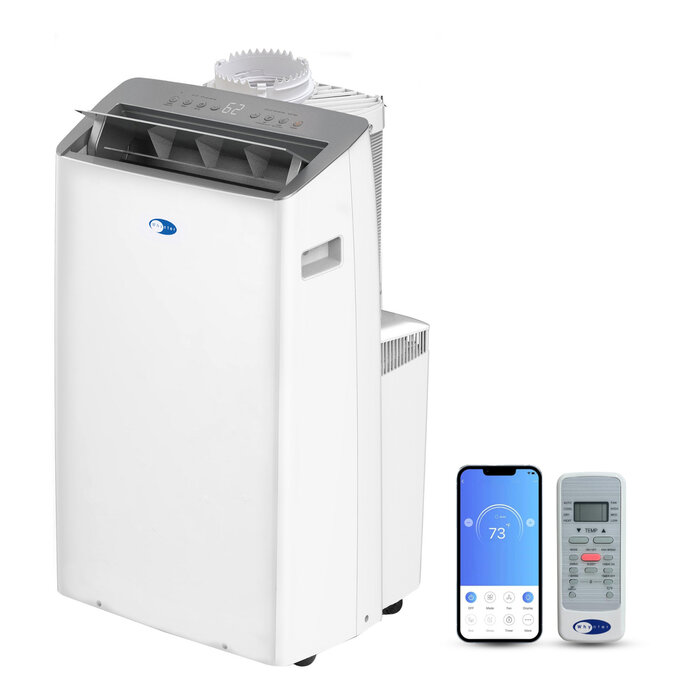
Models Worth a Look
These names come up again and again in 2026 roundups. We checked that they are still sold on the makers’ sites in October 2026. Prices move a lot with the season, so check before you buy.
- Midea Duo (MAP14S1TBL): hose-in-hose design and an inverter, 12,000 BTU SACC for rooms up to about 550 sq ft. Street prices have mostly sat around $500–$630, lower on sales.
- Whynter ARC-14S: a classic dual-hose unit with a slim body that saves floor space.
- Whynter ARC-1230WN: combines dual hoses with an inverter compressor.
- SereneLife SLPAC10: a simple budget unit for a small bedroom, office or studio. Keep it in a small room: in a large space it will run nonstop and still fall behind.
Watch: Why Portable ACs Are a Compromise
Technology Connections explains, with real measurements, why a single-hose unit fights itself and why a window unit beats it. It is long, but worth it before you spend $500.
Renter-Friendly Setup Tips
- Read your lease first. Portable units need no install, but check what it says about windows and modifications.
- Seal the window kit. Fill gaps around the hose panel with foam weatherstripping. It comes off cleanly when you move.
- Insulate the hose. An insulated sleeve cuts the heat the hose gives off back into the room.
- Keep the hose short and straight. Long, bent hoses trap heat and make the unit work harder.
- Schedule it. Use the unit’s built-in timer or app, or an infrared smart controller that works with its remote. Only use a smart plug if the manual allows it, and plug the unit straight into a wall outlet, never into an extension cord or power strip.
- Close the blinds on sunny windows so the AC isn’t fighting the sun.
- Plan for water. Some models evaporate the moisture they pull from the air. Others need draining, especially in humid weather.
Noise is the other trade-off. With the compressor in the room, a portable unit is louder than most people expect. For a bedroom, check the decibel rating and look for a sleep mode.
What Real Renters Say
These are individual experiences, summarized in our own words.
A renter on the 20th floor, where the building frowned on window units, bought a used single-hose portable rated at 8,500 BTU for a room of about 12 by 12 feet. On a hot day it brought the room from about 90°F down to about 80°F. Better than nothing, but not truly cool, which matches what the SACC rating predicts.
Source: Physics ForumsA homeowner had to remove a small 5,000 BTU window unit because of HOA rules. He replaced it with a 9,000 BTU single-hose portable. When it was above 90°F outside, he couldn’t get the bedroom below 75°F, while the old window unit had kept it cold. His view: a single-hose unit is like running a bathroom fan all day.
Source: Garage Journal forum- Sizing from the ENERGY STAR chart
- Real cooling (SACC) rather than the lab number (ASHRAE)
- Hose design, inverter and efficiency ratings (CEER/EER) from the makers’ specs
- Whether a renter can use it without permission, and availability in October 2026
Owner experiences come from forums, with links. We haven’t tested these products in person. No brand paid to be included.
When a Portable AC Isn’t Worth It
- Your lease allows a window unit. It will cool better for less money.
- You want to cool a whole apartment. One portable unit can’t do it well. Cool the room you use most and close the door.
- Your summers are long and very hot. A unit that runs all day for months costs a lot. Ask your landlord about a better fixed solution.
- The room has no window you can use. A unit without an exhaust to the outside only moves heat around the room.
Frequently Asked Questions
What size apartment air conditioner do I need?
Start with the ENERGY STAR chart: about 7,000 BTU for 250–300 sq ft and 12,000 BTU for 450–550 sq ft. Add 10% for a very sunny room, 600 BTU per extra person and 4,000 BTU for a kitchen. For a portable unit, use the SACC rating.
Is a dual-hose portable AC really better?
Yes, in most rooms. It doesn’t pull warm air in from the rest of the apartment, so it cools faster and wastes less power. It costs more and is bulkier.
How much does it cost to run a portable AC?
A unit drawing 1,100 watts for 8 hours a day over 90 days uses about 790 kWh. At 17¢ per kWh that is about $135 a year. Use the calculator with your own numbers.
Can I plug a portable AC into an extension cord or power strip?
Check the manual. Most makers say to plug it straight into a grounded wall outlet, because it draws a lot of power for hours.
Do I need my landlord’s permission?
Usually not for a portable unit, but read your lease, especially about window kits and drilling.
Our Verdict
If your lease allows a window unit, buy that. It is the most efficient apartment air conditioner for the money. If it doesn’t, choose a dual-hose or hose-in-hose portable with an inverter, sized by its SACC rating with the ENERGY STAR chart. Seal the window kit, keep the hose short, and cool one room at a time.
Keep reading
- Smart Blinds for Energy Savings: Which Windows Really Benefit: which windows benefit from smart blinds.
- Weatherstripping for Doors and Window Insulation Kits: What Works (2026): stop drafts at doors and windows.
- How to Lower Your Electric Bill in an Apartment (Renter-Friendly): cut your bill as a renter.