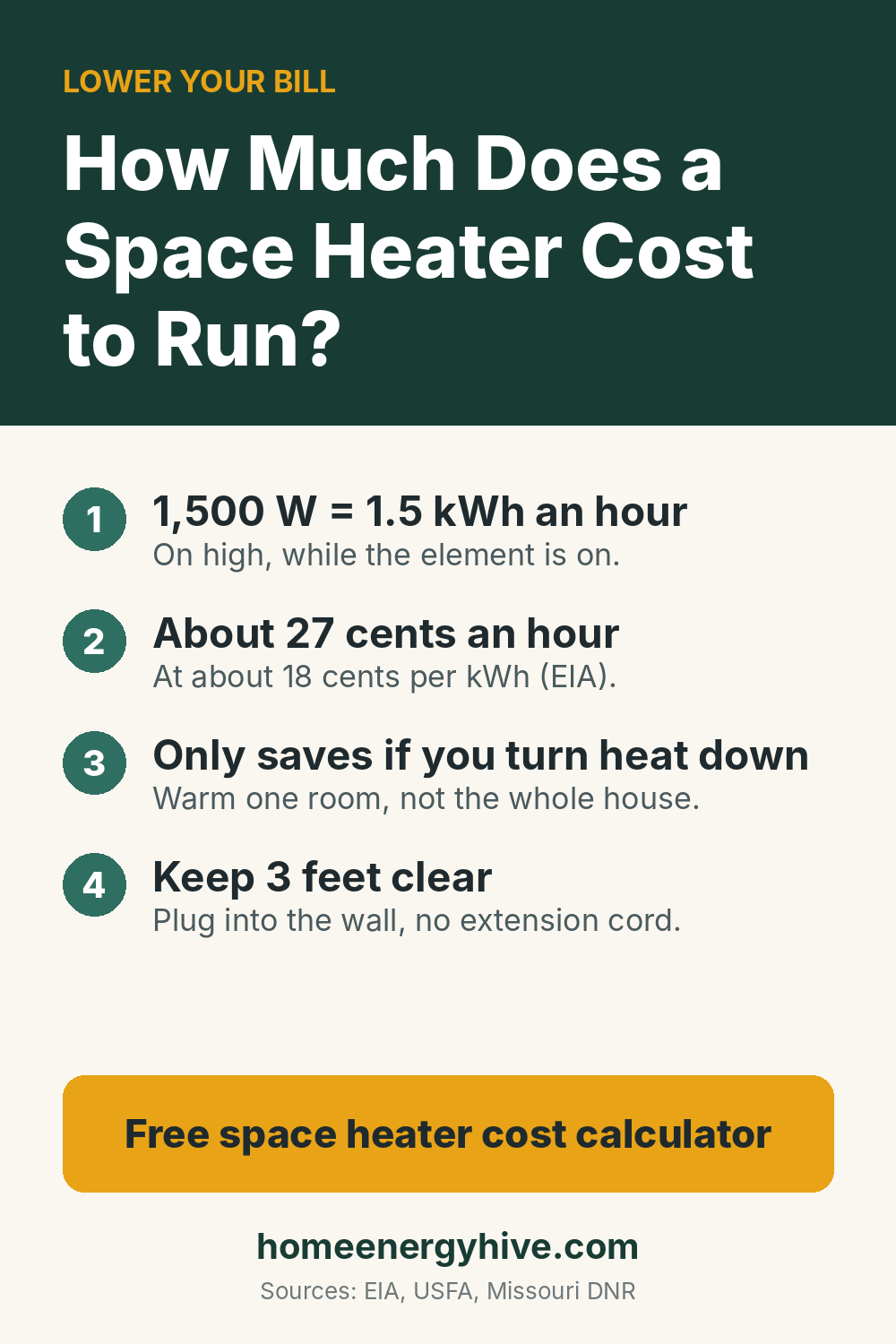
- A space heater uses its rated watts while the element is on. A 1,500-watt heater on high uses 1.5 kWh every hour.
- At the U.S. average residential price of about 18¢ per kWh (EIA, August 2026), that is about 27 cents an hour, or about $2.16 for 8 hours.
- A space heater only saves money if you turn the central heat down at the same time, as Missouri’s energy office explains.
- Portable heaters were only 3% of home heating fires but 41% of fatal heating fires (USFA, 2017–2019). Keep 3 feet clear and never use an extension cord.
How much electricity does a space heater use? More than most plug-in devices in your home, because it turns electricity straight into heat. That does not mean it is always a bad idea. Used in one room, with the rest of the house kept cooler, it can lower your bill. This guide shows the simple math, gives you a calculator, and covers the safety rules that matter far more than the cost.

How Much Electricity Does a Space Heater Use per Hour?
The answer is on the label: the watts. To turn watts into energy, divide by 1,000 and multiply by the hours. The Missouri Department of Natural Resources gives the formula as kilowatts × rate × time = cost, with this example: a 1,500-watt heater running for 10 hours at 10 cents per kWh costs $1.50.
| Heater setting | Energy per hour | Cost per hour at 18¢/kWh | 8 hours a day for 30 days |
|---|---|---|---|
| 1,500 W (high on many models) | 1.5 kWh | $0.27 | $64.80 |
| 750 W (low on many models) | 0.75 kWh | $0.14 | $32.40 |
Our calculation, assuming the element runs the whole time. The price is close to the U.S. residential average of 18.16¢ per kWh in August 2026 (EIA). Check your own heater’s watts on its label.
A heater with a thermostat switches its element on and off once the room is warm. In that case it uses less than the full rating. A plug-in electricity meter shows the real number.
Example values only. Cost = watts ÷ 1,000 × hours × share on × price.
Does a Space Heater Save Money?
Sometimes. Missouri’s energy office puts it plainly: if you turn your central heating down a few degrees and add heat only in a small area, you will probably save money. If you do not turn the thermostat down, the heater simply adds to your total bill.
The same fact sheet notes that electric resistance heaters are the most expensive form of heating. Every resistance heater is considered 100% efficient, because all the electricity becomes heat with no duct or combustion losses. However, the electricity itself costs more per unit of heat than many other sources. As a result, heating a whole house with plug-in heaters is generally more expensive than a gas furnace or a heat pump.
So a space heater makes sense for one room you use, for a few hours, while the rest of the house stays cooler. For example, a home office in the morning. For the whole house, look at your main system first; our guide to heat pump pros and cons explains one alternative.
Which Type of Space Heater Fits Your Room?
All electric resistance heaters turn the same watts into the same amount of heat. The difference is how they deliver it. Missouri’s fact sheet describes three types:
- Radiant heaters warm the people or objects in front of them almost instantly, but heat the room slowly. Good for one person at a desk or workbench. They get hot enough to cause a fire or a severe burn.
- Radiator-type (oil-filled) heaters give steady, even warmth to a room in constant use. They are slow to warm up, but their surface is not as hot as other types.
- Convection heaters with a fan warm a small area quickly, such as a bathroom or workshop. These also get hot enough to cause a fire or burn.
A built-in thermostat helps, because it stops the heater from running flat out once the room is warm. Many people also want a quiet model for bedrooms.
Space Heater Safety: The Rules That Matter Most
The U.S. Fire Administration reports that portable heater fires were only 3% of home heating fires in 2017–2019, but 41% of fatal heating fires. Follow these rules every time:
- Keep 3 feet clear. USFA says to keep anything that can burn at least 3 feet from heat sources, including space heaters.
- Turn it off when you leave the room or go to bed, as USFA advises.
- Plug it straight into the wall. Missouri’s fact sheet says never to use an electric heater with a common household extension cord. Heaters can overload circuits; if a breaker trips, the circuit is overloaded and you should call an electrician.
- Have working smoke alarms in rooms where you use a heater. Never run a gas space heater in a room without a working carbon monoxide alarm.
Cheaper Ways to Stay Warm
Before buying a heater, stop the heat from leaking out. Missouri’s energy office suggests caulking and weatherstripping around doors and windows, and cleaning or replacing the furnace filter on schedule. Our guide to the best weatherstripping for doors shows how. In winter you can also set your ceiling fan direction to clockwise on low to bring warm air down from the ceiling.
- Cost formula, heater types and safety advice from the Missouri Department of Natural Resources space heater fact sheet
- Fire figures and safety messages from the U.S. Fire Administration
- Electricity price from the EIA’s Electric Power Monthly
- The table and calculator are our own math
No company pays to appear here, and we have not tested products in person.
Frequently Asked Questions
How much electricity does a space heater use per hour?
Its rated watts divided by 1,000. A 1,500-watt heater on high uses 1.5 kWh per hour; a 750-watt setting uses 0.75 kWh. A thermostat that cycles the element on and off lowers the real figure.
How much does it cost to run a space heater for 8 hours?
At 18 cents per kWh, a 1,500-watt heater running the whole time costs about $2.16 for 8 hours. Use the calculator with your own price and hours.
Is it cheaper to use a space heater than central heat?
Only if you turn the central heat down and heat just the room you are in. Electric resistance heat is an expensive way to heat a whole house.
Can I plug a space heater into an extension cord or power strip?
No. Missouri’s energy office says never to use an electric heater with a common household extension cord. Plug it directly into a wall outlet.
Our Verdict
How much electricity does a space heater use? About 1.5 kWh an hour for a typical 1,500-watt model on high, or roughly 27 cents at today’s average price. That is fine for warming one room for a few hours while you turn the rest of the house down, but expensive as whole-house heat. Above all, keep 3 feet clear, plug it into the wall and turn it off when you leave the room.
Keep reading
- Ceiling Fan Direction for Winter and Summer: use your fan to spread warm air
- Best Weatherstripping for Doors: stop drafts first
- Why Is My Electric Bill So High?: find what is driving your bill
Save this guide on Pinterest