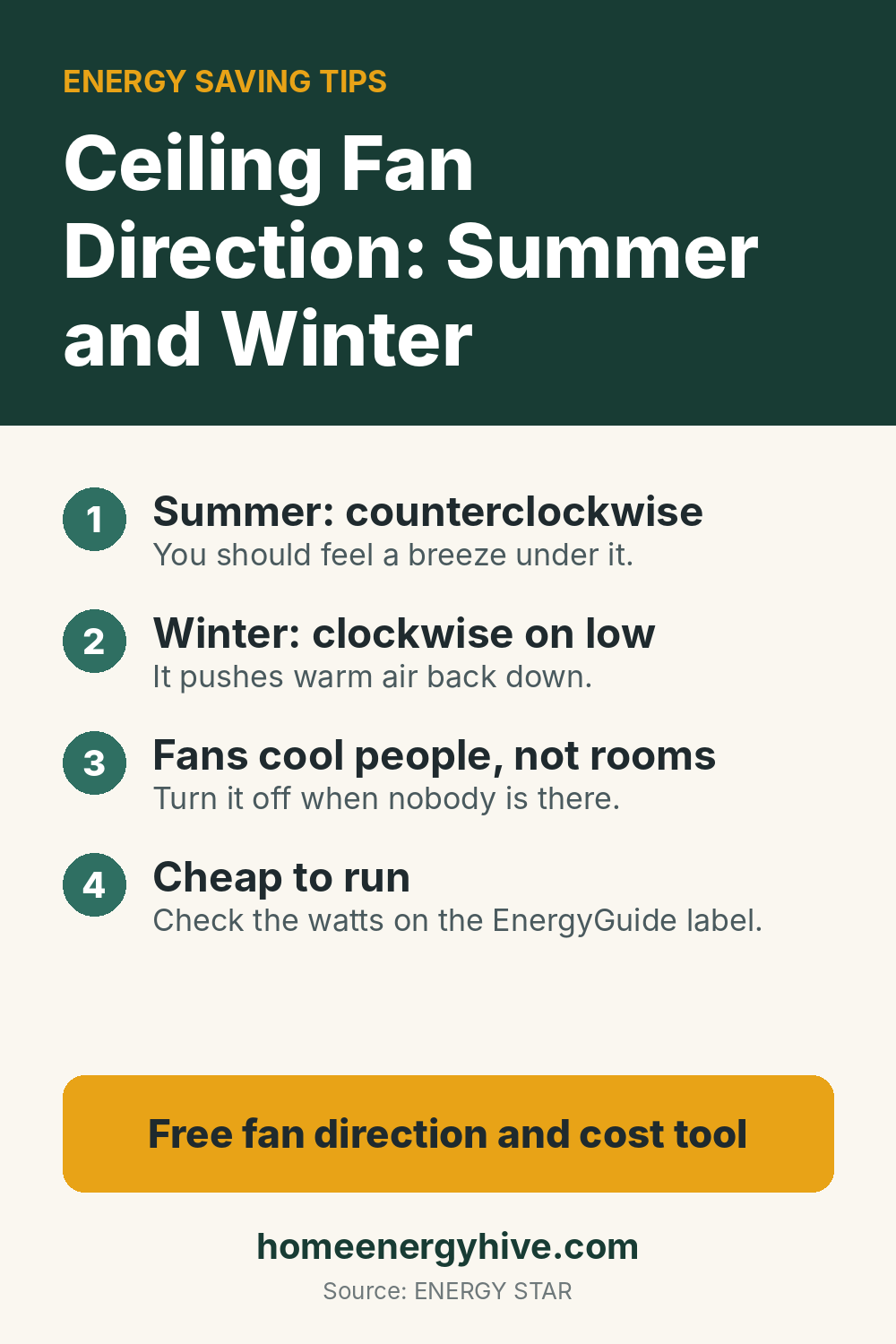
- Summer: run the fan counterclockwise (as you look up at it). You should feel a breeze when you stand under it.
- Winter: switch it to clockwise on low speed. That makes a gentle updraft that pushes warm air from the ceiling back down.
- A fan cools people, not rooms, so turn it off when nobody is there, as ENERGY STAR advises.
- Running a fan is cheap: the EnergyGuide label on the box gives its watts and yearly cost. Use the calculator below with your own numbers.
Getting the ceiling fan direction right is one of the easiest comfort fixes in a home. The same fan can make you feel cooler in July and spread warm air in January, but only if the blades turn the right way for the season. This guide explains which way to set it, how to switch it, and what a ceiling fan actually costs to run, using ENERGY STAR guidance and the federal EnergyGuide label.
Ceiling Fan Direction at a Glance
| Season | Direction (looking up) | Speed | What you should feel |
|---|---|---|---|
| Summer | Counterclockwise | Medium to high | A cool breeze under the fan |
| Winter | Clockwise | Low | Little or no breeze; air moves up, then down the walls |
These settings come from ENERGY STAR’s ceiling fan usage tips. Most fans follow this pattern, but a few models are built the other way round. So the simplest test is the breeze test: stand under the fan on medium speed. If you feel a steady draft, it is in summer mode.
Ceiling Fan Direction in Summer: Counterclockwise
In summer, the fan should push air straight down. ENERGY STAR explains that this moving air creates a wind-chill effect: the room is not colder, but you feel cooler because air moves across your skin. That is why a fan only helps the people sitting under it.
If you use air conditioning, the fan lets you feel comfortable at a slightly warmer setting. ENERGY STAR reminds owners to adjust the thermostat when they use a ceiling fan, because that is where the savings come from. In contrast, running the fan with the same thermostat setting only adds a little electricity use.
Ceiling Fan Direction in Winter: Clockwise on Low
Warm air rises, so in winter some of your heat collects near the ceiling. ENERGY STAR recommends reversing the motor and running the fan clockwise at low speed. This produces a gentle updraft: air goes up to the ceiling, spreads out and comes down the walls, bringing some of that warm air back to where you are.
Low speed matters. On high, even a clockwise fan can create a draft that makes you feel cooler, which defeats the purpose. If you feel a breeze while sitting in the room, turn the speed down.
Winter mode helps most in rooms with high or vaulted ceilings, where warm air can sit far above your head. With a low ceiling, the difference may be small.
How to Change Your Fan’s Direction
- Turn the fan off and wait until the blades stop completely.
- Find the reversing switch. ENERGY STAR notes that most fans have a motor reversing switch on the lower (switch) housing, just below the blades. It is usually a small slide switch.
- Flip the switch to the other position.
- Turn the fan back on and check: watch the blades from below, or do the breeze test.
Some newer fans have no switch on the housing. Instead, the direction button is on the remote control or a wall control. Check the manual if you cannot find it. Use a stable step ladder, and never reach into a moving fan.
How Much Does a Ceiling Fan Cost to Run?
Less than most people think. Every new ceiling fan box carries a yellow EnergyGuide label required by the FTC labeling rule. It shows the fan’s power use in watts, its airflow and its estimated yearly cost, based on 6.4 hours of use a day at 12 cents per kWh. For fans from 19 to 84 inches, the label compares the model with a cost range of $3 to $34 a year. At the label’s assumptions, that range works out to roughly 11 to 121 watts (our calculation).
Electricity now costs more than 12 cents in most of the country: the U.S. residential average was 18.16¢ per kWh in August 2026, according to the EIA. So use your own rate. Light kits are extra: the label excludes the lights.
Example values only. The cost is watts × hours × price; real use changes with the speed you choose.
Fans Cool People, Not Rooms
This is the most common mistake. In ENERGY STAR’s words, ceiling fans cool people, not rooms. A fan spinning over an empty bedroom all day does nothing useful, so switch it off when you leave. In summer, the savings come from raising the thermostat a little while the fan keeps you comfortable. Our guide to smart thermostat energy savings shows how to schedule those changes.
Winter is different: the goal there is mixing, not wind chill. Low speed in an occupied room with a high ceiling makes the most sense.
Is Your Fan Wobbling or Humming?
A wobbly fan is usually a balance problem. ENERGY STAR suggests first checking that every connection is tight. Then hold a yardstick vertically at the edge of each blade to see if one sits higher or lower than the others. A balancing kit, often included in the box, can find the blade that needs a small weight.
A humming motor can come from the wrong control. ENERGY STAR warns that running a fan from a conventional dimmer switch can make the motor hum. Use a fan speed control made for your model.
When a New Fan Makes Sense
If your fan is old, noisy or weak, a new one can move more air for fewer watts. ENERGY STAR certified ceiling fans are up to 44% more efficient than conventional fans, thanks to better motors and blade designs. Compare the airflow efficiency on the EnergyGuide label: the higher the cubic feet per minute per watt, the better.
- Low ceilings: look for a “hugger” fan, which ENERGY STAR defines as one whose blades sit 10 inches or less from the ceiling.
- Installation: ENERGY STAR notes that fans can weigh up to 50 pounds and need a UL-listed metal box marked “For Use With Ceiling Fans.” If you are replacing a light fixture, the old box often has to be replaced. Hire an electrician if you are not sure.
- Directions and usage advice from ENERGY STAR’s ceiling fan pages
- Label facts from the FTC Energy Labeling Rule (16 CFR 305.21)
- Electricity price from the EIA’s Electric Power Monthly
- The calculator is our own: watts × hours × price
No company pays to appear here, and we have not tested products in person.
Frequently Asked Questions
Which way should a ceiling fan turn in winter?
Clockwise, on low speed, as seen from below. ENERGY STAR says this creates a gentle updraft that brings warm air from the ceiling back down into the room.
Which way should a ceiling fan turn in summer?
Counterclockwise. You should feel a breeze when you stand under it. The moving air makes you feel cooler, even though the room temperature does not change.
Should I leave the ceiling fan on all the time?
No. Fans cool people, not rooms, so turn the fan off when nobody is in the room.
How do I know which way my fan is turning?
Turn it on medium and stand underneath. A steady breeze means summer mode (counterclockwise on most fans). Little or no breeze, with the blades still turning, means winter mode.
Our Verdict
Set your ceiling fan direction twice a year: counterclockwise for a cooling breeze in summer, clockwise on low in winter to bring warm air down. Turn the fan off in empty rooms, and pair it with a slightly higher thermostat setting in summer. A typical fan costs only a few dollars a year to run, so the real savings come from how you use your heating and cooling around it.
Keep reading
- Smart Thermostat Energy Savings: set your heating and cooling schedule
- Average Electric Bill by State: see how your bill compares
- Energy Saving Myths: what really saves and what does not
Save this guide on Pinterest